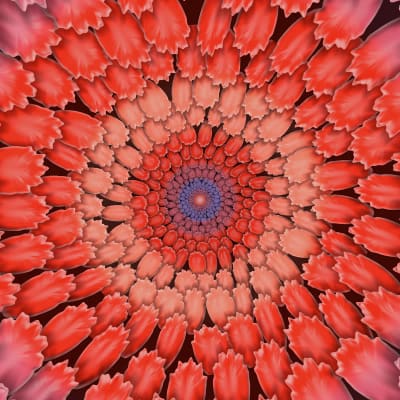
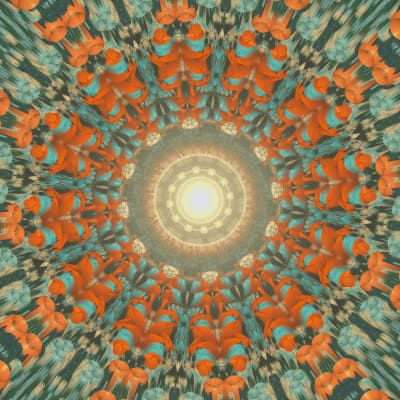
Visual meditation is meditation with your eyes open. You rest your gaze on one gentle thing, such as a candle flame, moving water, drifting clouds or a slowly turning pattern, and let your attention settle there. When your mind wanders, you come back to what you're seeing. Many people find it easier than closed-eye meditation, especially when their thoughts are loud or they keep falling asleep.
How is visual meditation different from regular meditation?
Meditation researchers often describe two broad styles [1]:
- Focused attention: you keep your attention on one chosen object, notice when it drifts, and bring it back.
- Open monitoring: you widen your awareness and simply notice whatever comes and goes, without holding on to any of it.
Visual meditation can be either. Staring softly at a candle flame is focused attention with a visual anchor. Sitting by a window and letting the movement of the trees wash over you is closer to open monitoring. The US National Center for Complementary and Integrative Health lists a visual image as one of the objects focused-attention meditation can use, alongside the breath, a sound or a mantra [2].
The main difference is practical. With eyes closed, your attention has only inner objects to rest on: the breath, the body, thoughts. With eyes open, you have something outside you that's always there and always gently changing. For a restless mind, that can make the anchor easier to find.
Why do slow visuals feel so restful?
In the 1990s, psychologist Stephen Kaplan proposed attention restoration theory. His idea: the kind of attention we use for work, traffic and screens is effortful and gets tired. Some things, though, hold our attention without effort. He called this "soft fascination": clouds, sunsets, leaves moving in the breeze, water. They occupy the eyes lightly and leave room for the mind to rest and reflect [3].
Research has tested parts of this. In a well-known study, people who walked in nature, or even just viewed pictures of nature, did better afterwards on tests of directed attention than people who walked in a city or viewed city scenes [4]. A 2018 systematic review of 42 studies found that exposure to natural environments, or to images of them, was linked to modest improvements in working memory and mental flexibility, with real environments possibly stronger than virtual ones [5].
Two honest caveats. Most of this research is about nature, not screens. And it measures attention, not calm directly. Still, it matches what many people notice: watching something slow and gentle feels very different from scrolling something fast.
What is trataka?
Trataka is a yoga practice of steady gazing. Traditionally you look at a candle flame at eye level, keep your gaze soft and steady for a while, then close your eyes and watch the afterimage fade.
There's a small amount of research on it. In a 2014 trial, 60 older adults were split into a trataka group and a wait-list group. After a month of practice, the trataka group did better on some tests of attention and mental flexibility [6]. It's one small study, so treat it as interesting rather than proven.
If you try it, keep the flame at a comfortable distance, blink whenever you need to, never stare at the sun or a bright lamp, and never leave a candle burning unattended.
How do you try visual meditation?
- Choose something slow. A candle flame, rain on a window, clouds, leaves, a fish tank, or a slow, smooth animation.
- Sit comfortably. Keep your back supported and the object at least an arm's length away, roughly at eye level.
- Soften your gaze. Look at it as if you were looking through it. Blink normally; this isn't a staring contest.
- Breathe slowly. If it helps, breathe out a little longer than you breathe in.
- Notice details. Colours, edges, the way it moves, how the light changes.
- Come back when you drift. Your mind will wander to plans and worries. Notice it, and return to what you see. That return is the practice.
- Close your eyes at the end. Take three slow breaths before getting up.
Start with three to five minutes. If you like it, stretch toward ten or fifteen.
What can you look at?
| What to look at | Style | Good for |
|---|---|---|
| Candle flame | Focused, trataka-style | Evening wind-down at home |
| Rain, a river, the sea | Soft, open | A break when you're overloaded |
| Clouds or trees | Soft fascination | Outdoors, or by a window |
| A slow generative pattern on a screen | Soft, guided | When you can't get outside; at night, keep it dark and dim |
Can a screen work for visual meditation?
It can, if the screen is doing something calm. A slow, smooth, predictable visual is closer to watching water than to scrolling a feed. A few guidelines help: choose slow motion over fast cuts, dark colours at night, no flashing, low brightness, and a clear end point so it doesn't turn into an hour.
And when you can, go outside. The research suggests the real thing may work better than the picture [5].
If you have epilepsy or are sensitive to flashing lights or patterns, read our guide to photosensitivity and calming visuals before trying any moving visuals, and check with your doctor.
Who should be careful with meditation?
Meditation is usually considered low risk, but it isn't risk-free. The NCCIH notes that few studies have looked carefully at harms, and that in one review about 8 percent of participants reported a negative effect, most often anxiety or depression [2]. If a practice stirs up distress, stop, open your eyes, and ground yourself in the room. If you live with a mental health condition, talk to your doctor or therapist about which practices suit you. For quick, practical ways to settle a hard moment, see how to calm down in 60 seconds.
Is there an app for visual meditation?
Stillfy was built around this idea: you open it and you're already flying through a slow, endless tunnel, mandala or petals, drawn live on your phone, so there's always something gentle to rest your eyes on. It's free, with no ads and no sign-in, and also runs in any browser at stillfy.com/fly.
Sources
- Lutz A, Slagter HA, Dunne JD, Davidson RJ (2008). Attention regulation and monitoring in meditation. Trends in Cognitive Sciences. link
- National Center for Complementary and Integrative Health (2022). Meditation and mindfulness: effectiveness and safety. NIH. link
- Kaplan S (1995). The restorative benefits of nature: Toward an integrative framework. Journal of Environmental Psychology. link
- Berman MG, Jonides J, Kaplan S (2008). The cognitive benefits of interacting with nature. Psychological Science. link
- Stevenson MP, Schilhab T, Bentsen P (2018). Attention Restoration Theory II: a systematic review to clarify attention processes affected by exposure to natural environments. Journal of Toxicology and Environmental Health, Part B. link
- Talwadkar S, Jagannathan A, Raghuram N (2014). Effect of trataka on cognitive functions in the elderly. International Journal of Yoga. link
Questions and answers
What is visual meditation?
Visual meditation is meditation with your eyes open. You rest your gaze on one gentle thing, such as a candle flame, moving water, clouds or a slow pattern, and when your mind wanders you bring your attention back to what you're seeing.
Can you meditate with your eyes open?
Yes. Many traditions use an open-eyed gaze, and focused-attention meditation can use a visual image as its anchor instead of the breath or a sound. Some people find open eyes easier because it keeps them present and less sleepy.
What is soft fascination?
Soft fascination is a term from attention restoration theory for things that hold your attention gently and without effort, like clouds, leaves in the wind or flowing water. They're thought to give your tired, effortful attention a chance to rest.
What is trataka?
Trataka is a yoga practice of steady gazing at a small object, traditionally a candle flame, often followed by closing the eyes and watching the afterimage. A small 2014 trial in older adults linked a month of trataka to better scores on some attention tests.
How long should visual meditation last?
Three to five minutes is enough to start. You can build up to ten or fifteen minutes if it feels good. A short practice you actually do is worth more than a long one you skip.
This article is for general information and isn't medical advice. If you are in danger or thinking about harming yourself, see our Safety page for helplines.